How Instant Coffee Is Made:
Complete Instant Coffee
Manufacturing Process Explained

Figure: Instant coffee granules being added to a cup of hot water.
Instant coffee has become a global staple across retail, food service, and beverage manufacturing. From supermarket shelves to ready-to-drink beverages and vending systems, instant coffee provides a convenient and scalable way to deliver coffee flavor in a soluble format. For coffee brands, beverage companies, and food manufacturers, understanding the instant coffee manufacturing process is essential when developing products or working with an OEM partner.
Unlike traditional brewed coffee, instant coffee undergoes an industrial production process that extracts soluble compounds from roasted coffee beans and converts them into stable powder or granules. The two primary technologies used in instant coffee production are spray drying and freeze drying, each offering different advantages in cost, flavor retention, and product positioning.
This guide explains how instant coffee is made, outlining the key manufacturing stages and the technologies used by professional coffee manufacturers.
What Is Instant Coffee?

Figure: Instant coffee granules in jars.
Instant coffee, also known as soluble coffee, is a dehydrated form of brewed coffee that dissolves quickly in hot or cold water. Instead of grinding coffee beans and brewing them fresh, instant coffee allows consumers and food manufacturers to prepare coffee beverages instantly.
The product is widely used across several industries:
- Retail packaged coffee products
- Ready-to-drink coffee beverages
- 3-in-1 coffee mixes
- Food manufacturing and bakery applications
- Vending machines and office coffee systems
Because instant coffee dissolves rapidly and offers a long shelf life, it is particularly valuable for large-scale beverage production and global distribution.
Overview of the Instant Coffee Manufacturing Process
The instant coffee manufacturing process converts roasted coffee beans into soluble powder or granules through several industrial stages.
The typical production flow includes:
- Coffee bean sourcing
- Roasting
- Grinding
- Coffee extraction
- Concentration of coffee extract
- Drying (spray drying or freeze drying)
- Agglomeration (optional)
- Packaging and quality control
Each step plays a critical role in shaping the final flavor profile, solubility, and appearance of the instant coffee product.
Step 1: Coffee Bean Selection and Roasting
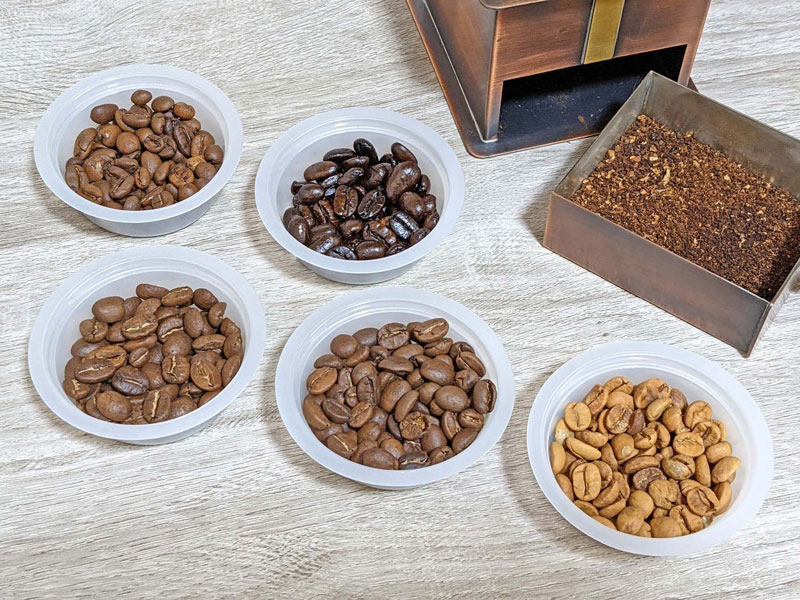
Figure: Different coffee beans showcasing various roast levels and selection stages.
The process begins with selecting suitable coffee beans. Both Arabica and Robusta varieties are commonly used in instant coffee production.
Arabica beans typically provide:
- Smoother flavor
- Higher acidity
- More aromatic complexity
Robusta beans contribute:
- Stronger body
- Higher caffeine content
- Improved cost efficiency
Many instant coffee manufacturers use carefully balanced blends to achieve the desired flavor profile.
Once the beans are selected, they are roasted using industrial roasting systems. Roast profiles for instant coffee may differ slightly from those used for traditional brewing because the extraction process later concentrates the coffee compounds.
Manufacturers often optimize roasting to maximize soluble solids yield and flavor stability.
Step 2: Grinding and Coffee Extraction
After roasting, the coffee beans are ground to increase surface area and prepare them for extraction.
Industrial instant coffee facilities typically use multi-stage extraction systems similar to large-scale brewing operations. The ground coffee passes through a series of extraction columns where hot water dissolves soluble coffee compounds.
This stage produces a liquid known as coffee extract.
Extraction parameters are carefully controlled, including:
- Temperature
- Pressure
- Extraction time
- Water flow rate
Efficient extraction is essential for maximizing flavor while ensuring consistent product quality.
Step 3: Concentrating on the Coffee Extract
The extracted coffee liquid initially contains a relatively low concentration of dissolved solids. Before drying can occur, manufacturers increase this concentration through evaporation.
During the concentration stage, excess water is removed using industrial evaporators. This process raises the coffee solids concentration, making the liquid more suitable for drying.
Another important component of this stage is aroma recovery. Because volatile aroma compounds may evaporate during concentration, manufacturers often capture and store these aromas so they can be reintroduced later in the process. This helps maintain the characteristic smell and taste of coffee.
Step 4: Drying the Coffee Extract
The concentrated coffee extract must then be converted into a dry form. This step is what ultimately produces instant coffee powder or granules.
Two primary technologies are used in industrial instant coffee production:
- Spray drying
- Freeze drying
Each method removes moisture from the coffee extract while preserving soluble coffee compounds.
Spray Dried Coffee Process

Figure: Spray-dried coffee powder illustrating the final instant coffee form.
Spray drying is the most widely used method in large-scale instant coffee manufacturing.
In the spray dried coffee process, the concentrated coffee extract is pumped into a tall drying chamber where it is atomized into tiny droplets through high-pressure nozzles. These droplets encounter hot air inside the drying tower, causing moisture to evaporate almost instantly.
The remaining dry particles fall to the bottom of the chamber as fine coffee powder.
Key characteristics of spray dried coffee include:
- Efficient high-volume production
- Relatively lower manufacturing cost
- Fine powder texture
- Strong solubility
Because of its scalability and efficiency, spray drying is commonly used for mass-market instant coffee products and food manufacturing applications.
Learn more about spray dried coffee.
Freeze Dried Coffee Process

Figure: Freeze-dried coffee granules alongside prepared coffee cups.
Freeze drying is a more complex process designed to preserve delicate coffee aromas.
In the freeze dried coffee process, the concentrated coffee extract is first frozen into solid blocks. These frozen slabs are then placed in a vacuum chamber where the ice is removed through sublimation, meaning the ice transitions directly from solid to vapor without becoming liquid.
As moisture is removed, the coffee forms large porous granules.
Key characteristics of freeze dried coffee include:
- Better aroma preservation
- Larger, premium-looking granules
- Higher perceived quality
- Higher production cost
Freeze dried coffee is often used for premium instant coffee brands.
Spray Dried vs Freeze Dried Coffee: Key Differences
Both manufacturing technologies produce soluble coffee, but their characteristics differ.
| Factor | Spray Dried Coffee | Freeze Dried Coffee |
|---|---|---|
| Production method | Atomization with hot air drying | Frozen extract dried via vacuum sublimation |
| Aroma retention | Moderate | High |
| Particle structure | Fine powder | Large porous granules |
| Production cost | Lower | Higher |
| Typical market use | Mass-market products, mixes | Premium instant coffee |
Manufacturers choose the technology based on product positioning, cost targets, and flavor requirements.
Agglomeration and Particle Engineering
After drying, the coffee powder may undergo a process known as agglomeration.
Agglomeration clusters small powder particles into larger granules. This process improves several product characteristics:
- Faster dissolution in water
- Reduced dust during packaging
- Improved appearance
- Better flowability during filling
Agglomerated instant coffee is commonly used in retail jars and sachet products.
Packaging and Quality Control
Once the instant coffee is produced, it must be carefully packaged to maintain freshness and product stability.
Packaging systems are designed to control:
- Moisture exposure
- Oxygen levels
- Contamination risks
Common packaging formats include:
- Glass jars
- Laminated sachets
- Bulk industrial bags
- Food manufacturing supply packs
Quality control procedures typically include testing for:
- Moisture content
- Particle size
- Solubility
- Flavor profile
- Microbiological safety
Maintaining consistent quality is essential for manufacturers supplying coffee brands and global food companies.
Why Coffee Brands Work With Instant Coffee OEM Manufacturers
Producing instant coffee requires significant industrial infrastructure and technical expertise. Manufacturing facilities must operate complex roasting systems, extraction columns, evaporation equipment, and drying towers.
For many coffee brands and beverage companies, building these capabilities internally is not practical.
Instead, companies often partner with instant coffee OEM manufacturers who specialize in producing soluble coffee at scale.
Working with an experienced manufacturer allows brands to benefit from:
- Advanced coffee processing technology
- Consistent product quality
- Scalable production capacity
- Custom blend development
- Reduced capital investment
OEM partnerships are particularly valuable for brands developing private label coffee products, beverage ingredients, or instant coffee mixes.
Explore coffee OEM manufacturing and coffee bean distribution services.
Conclusion
Instant coffee production is a sophisticated industrial process that transforms roasted coffee beans into soluble powder or granules. Through stages such as extraction, concentration, and drying, manufacturers are able to preserve the flavor and aroma of coffee in a convenient format.
Both spray drying and freeze drying technologies play important roles in the industry, each offering different advantages depending on the desired product characteristics and market positioning.
Understanding the instant coffee manufacturing process helps coffee brands, product developers, and procurement teams make informed decisions when sourcing instant coffee products or developing new beverage formulations.
Explore Instant Coffee Manufacturing With HACO
For companies looking to develop instant coffee products, working with an experienced manufacturing partner can simplify product development and ensure consistent quality.
HACO Asia Pacific supports coffee brands, beverage companies, and food manufacturers with OEM coffee manufacturing solutions, including custom instant coffee development and sourcing expertise.
Learn more about:
To explore how HACO supports businesses across the coffee value chain.
Contact Us Now
We are happy to be at your service.
For inquiries, please send us a message. We will respond to your inquiry via email,
or you may reach out to us via WeChat.
Click here for the WeChat QR Code Scan..